
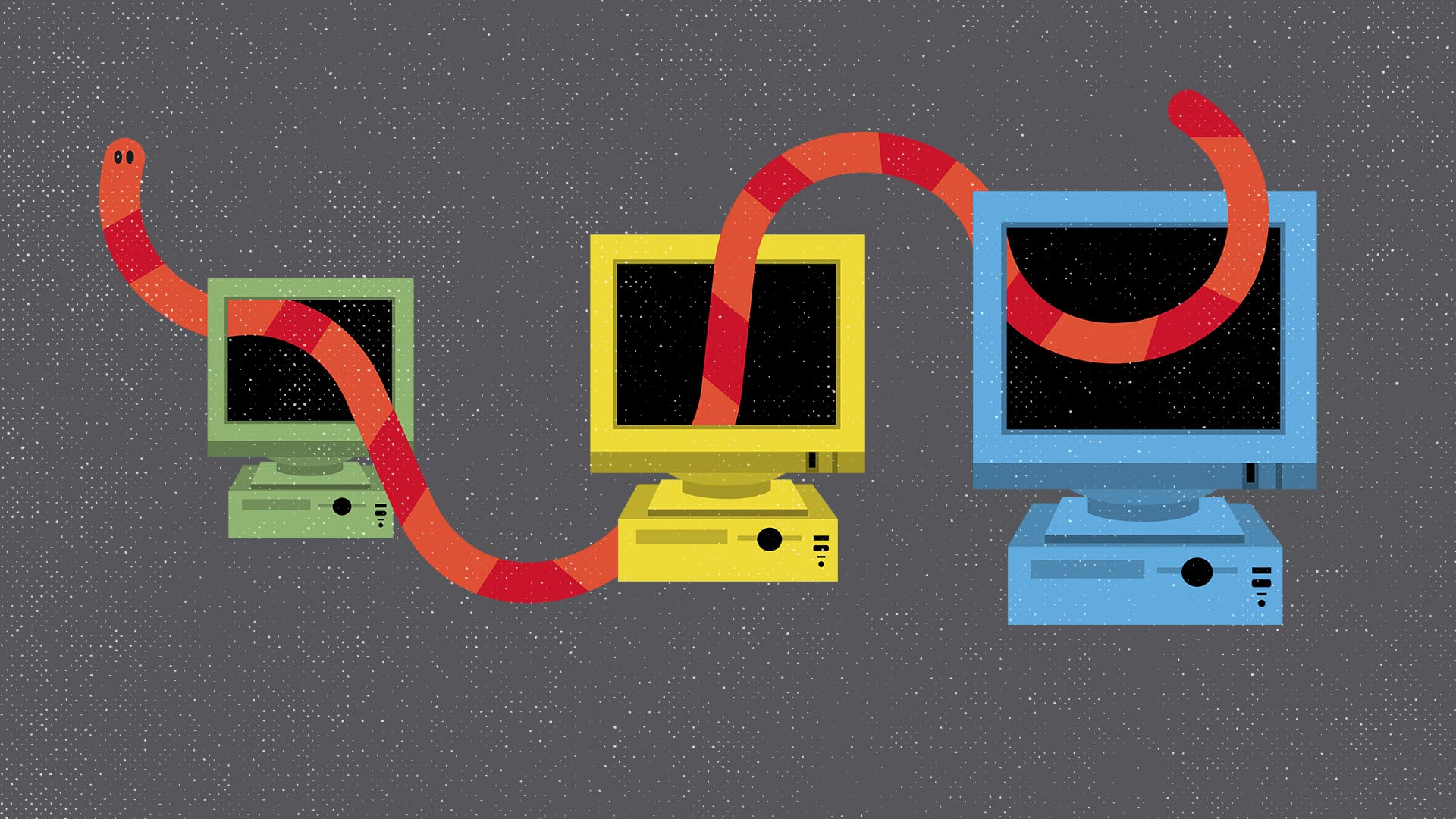
At 8:30 p.m. on November 2, 1988, a graduate student at Cornell University named Robert Tappan Morris connected to a computer at MIT and executed a piece of code he had spent months writing. Morris released it from MIT rather than Cornell because he did not want the program traced back to his own institution. And that decision, though small and sneaky in the moment, would later matter a great deal to federal prosecutors.
What he released onto the early internet that evening was the first self-replicating worm to gain widespread public attention, which became one of the most consequential pieces of code ever written. Not because of what it destroyed, but because of the destructive capability it reverberated.
Morris was not trying to cause damage. His stated intent, corroborated by people who knew him and largely accepted by the court that later convicted him, was to measure the size of the internet by mapping how far a self-propagating program could travel. But the worm had a design flaw, and that flaw transformed an experiment into a crisis. Morris had built in a mechanism to prevent the worm from reinfecting machines it had already compromised, but he worried that administrators might exploit this check by simulating an infected state to repel it. So he coded an override. One in seven times, the worm would reinfect a machine it had already reached regardless of what the check returned. On a network of sixty thousand machines, that fraction was enough to cause systems to run the worm process repeatedly until they slowed, then stopped. And within twenty-four hours, an estimated six thousand machines had been hit, according to the FBI's account of the incident. People spent three days attempting a manual response with no automated tool to match what was propagating against them.


How the Morris Worm Actually Worked
The technical architecture of the Morris Worm is worth examining carefully, because it established a template that offensive tools have been refining ever since. The worm did not rely on a single vulnerability, but attacked through four separate vectors simultaneously, which is what allowed it to spread as fast as it did across a network running different hardware configurations and software versions.
The first vector was a debug backdoor in the Unix sendmail program. Sendmail handled electronic mail routing across the network, and its debug mode, intended for administrative troubleshooting, accepted arbitrary commands from remote hosts when enabled. Morris exploited this to execute code on target systems without authentication. The second vector was a buffer overflow in the finger daemon, a Unix service that allowed users to look up information about other users on the network. By sending a carefully constructed string longer than the buffer allocated to receive it, Morris could overwrite adjacent memory and redirect execution to his own code, a technique that remains one of the most durable in offensive security three decades later. The third vector exploited the trust relationships built into Unix remote shell commands. Systems configured to trust each other for administrative convenience would execute commands from trusted hosts without requiring a password, and the worm used any foothold it gained to propagate outward through those trust chains. And the fourth vector was a password cracker. The worm carried a list of common passwords and attempted them against user accounts, expanding its access on any system where administrators or users had chosen weak credentials.
None of these vulnerabilities were unknown to the research community. The sendmail debug backdoor had been flagged before. The risks of buffer overflows were understood in principle. And the dangers of promiscuous trust relationships in rsh and rexec configurations had been discussed in academic circles. What the Morris Worm widely demonstrated was that knowing about a vulnerability and closing it before an automated system exploited it at scale were two entirely different problems. The worm did not give security practitioners time to patch and coordinate. It moved faster than the communication channels that would have been needed to mount an organized response.
No One Knew What to Do
What happened on the defending side of that night is as analytically significant as what the worm did technically. Eugene Spafford, then a professor at Purdue University and one of the first researchers to conduct a detailed technical analysis of the worm, later documented the response in a paper for the ACM that remains one of the clearest accounts of what it looked like when an automated offensive tool encountered a defensive apparatus built entirely around human coordination, according to his 2003 retrospective published through Purdue's CERIAS (Spafford, A Failure to Learn from the Past, CERIAS/ACSAC 2003 — acsac.org/2003/papers/classic-spafford.pdf). Administrators at affected institutions learned about the outbreak through phone calls, through personal contacts at other universities, through messages on mailing lists that were themselves running on systems being slowed by the worm. There was no central coordination mechanism. There was no shared incident database. There was no automated detection system that could identify the worm's signature across the network and alert affected parties simultaneously.
The teams that ultimately reverse-engineered the worm and developed countermeasures did so by obtaining copies of the executable, decompiling it, and working through its logic manually over the course of the first night and into the following day. A group at Berkeley, a group at MIT, and researchers at several other institutions worked in parallel, communicating over the same degraded network the worm was attacking. The fix, when it came, had to be distributed the same way. Administrators at institutions that had disconnected their machines from the network to stop the worm from spreading could not receive the patch until they reconnected. Some systems remained down for a week.
The asymmetry that this response exposed was not a failure of individual competence. The people who responded were among the best computer scientists in the country, working at the institutions that had built the internet. The asymmetry was structural. The worm operated automatically, propagating continuously without requiring any further action from Morris after the initial execution. The defense operated manually, requiring human judgment at every step, coordination across institutions that had no established protocols for doing so, and communication over infrastructure the attack was degrading in real time.
What Happened to Morris and What the Government Did Next
Morris was identified within days. The FBI launched an investigation, recovered code from his accounts, interviewed associates, and built a case under the 1986 Computer Fraud and Abuse Act. He was indicted in 1989 and convicted in 1990, becoming the first person convicted under that statute, according to the FBI's historical record of the Morris Worm case. His sentence was three years of probation, four hundred hours of community service, and a fine of ten thousand dollars. The defense argued that he had not intended to cause damage and that the damages did not meet the required legal threshold. The court disagreed. Morris later went on to co-found the startup accelerator Y Combinator and became a professor at MIT, a trajectory that says something about how the research community processed the incident relative to how the legal system did.
The more durable institutional response came from the Department of Defense. Within days of the incident, at the direction of DARPA, Carnegie Mellon University established the Computer Emergency Response Team, known as CERT. Its mandate was to serve as a coordination center for cybersecurity incidents on the internet, providing a shared communication infrastructure that the 1988 response had demonstrated did not exist. CERT represented the first institutional acknowledgment that the internet had an attack surface that required organized, ongoing defensive attention rather than ad hoc responses assembled from scratch each time something went wrong.
But CERT was a coordination mechanism, not an automated one. It improved the speed at which human defenders could communicate and share information. It did not close the fundamental gap between a worm that could propagate at machine speed and a defense that still depended on humans reading emails, making phone calls, and manually deploying fixes.
History Repeats and Still Matters Today
Every major automated offensive development since 1988 has operated within the structural framework the Morris Worm established. The worm itself was not weaponized. It had no payload designed to exfiltrate data, destroy files, or hold systems for ransom. But the principle it demonstrated, that a single piece of code could propagate autonomously across a network faster than defenders could respond, became the foundation on which every subsequent generation of automated offensive tooling was built.
The ILOVEYOU worm in 2000 used email attachment propagation to reach fifty million machines in ten days. Code Red in 2001 exploited a buffer overflow in Microsoft IIS servers and infected three hundred sixty thousand machines in fourteen hours. SQL Slammer in 2003 infected seventy-five thousand systems in ten minutes, doubling in size every 8.5 seconds during its first thirty seconds of execution, according to Moore, Paxson, Savage, Shannon, Staniford, and Weaver in their analysis published in IEEE Security and Privacy, vol. 1, no. 4, July-August 2003 (caida.org/publications/papers/2003/sapphire2). Each of these events ran on the same asymmetry the Morris Worm had introduced. The offense was automated. The defense was not.
What has changed in the decades since is the capability of the automated tools on the offensive side, not the structural relationship between offense and defense. Signature-based scanning tools gave way to exploit frameworks. Exploit frameworks gave way to autonomous tooling that can reason about the environments it encounters rather than simply matching conditions against known patterns. The CyberStrikeAI campaign confirmed against FortiGate infrastructure in early 2026, which compromised over six hundred devices across fifty-five countries with no human operator directing individual steps, is a direct descendant of the Morris Worm in operational concept, according to Hadrian's research team. The underlying asymmetry has not changed. It has industrialized.
What 1988 Actually Established
The Morris Worm is remembered primarily as a legal landmark and a historical curiosity, the first major internet incident, the first conviction under the CFAA, the event that created CERT. Those facts are accurate but they understate what actually happened on November 2, 1988.
What Morris established that night, without intending to, was a structural condition that has governed the attacker-defender relationship ever since. Automated offense is faster than manual defense. That is not a temporary imbalance that better tools or more funding can close as long as the defense depends on human coordination at each step of the response chain. The only answer to automated offense operating at machine speed is automated defense operating at equivalent scale, with governance built into the architecture rather than added on top afterward.
That answer is only now beginning to take operational form, thirty-seven years later. The organizations building autonomous defensive agents today are not solving a new problem. They are finally building the appropriate response to the problem Morris accidentally introduced in 1988. The head start attackers got that night has never gone away. Closing it requires operating at the same tempo that created it.