
Most breaches still start with a person doing something that looks like part of the job. A developer pastes an install command, a help desk agent resets a password, or an employee follows instructions from a page that exploits nothing. AI now writes those requests in fluent, polished language, and the usual warning signs disappear.
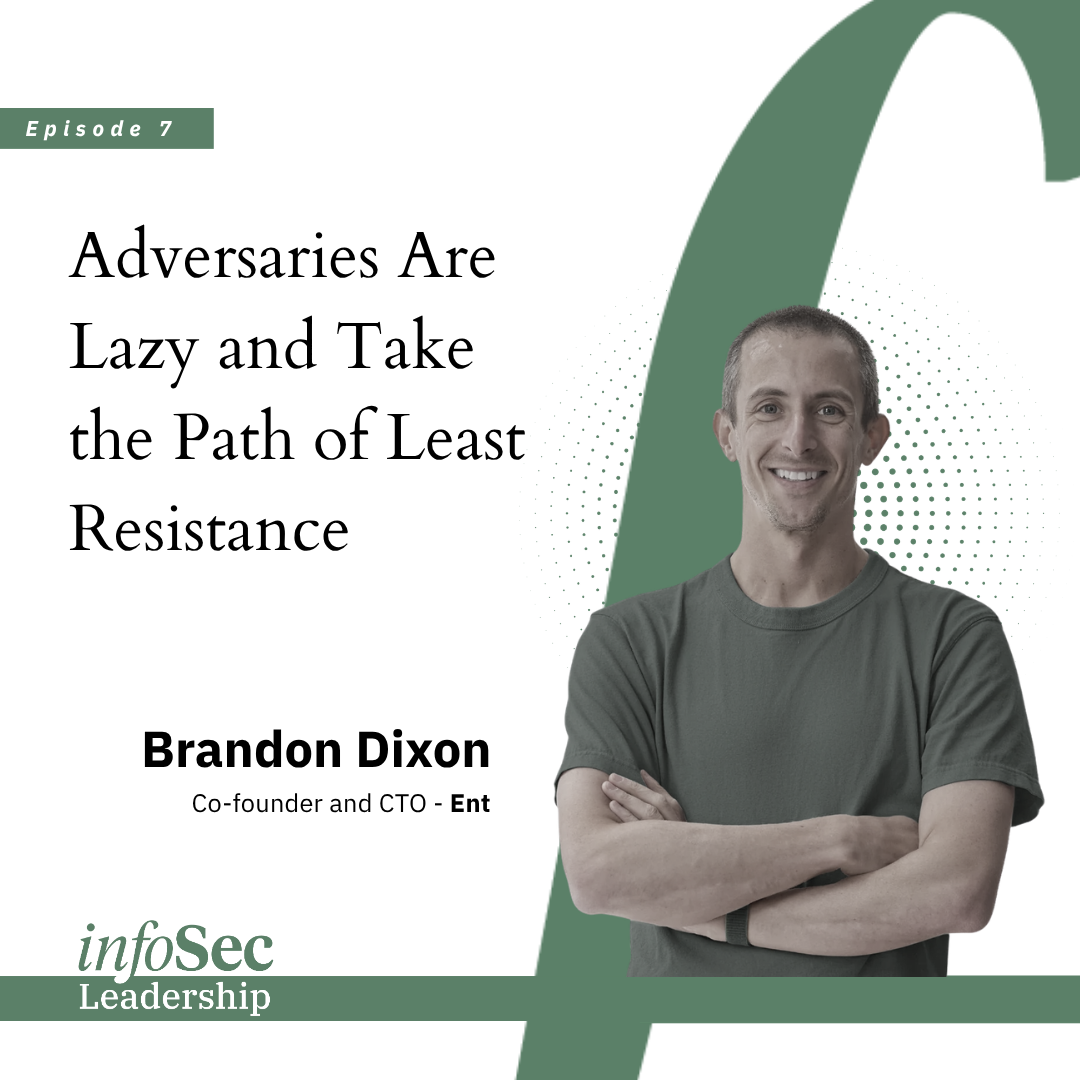
Brandon Dixon is co-founder and CTO of Ent. He started his career helping build a lab that simulated the internet inside a SCIF, then tracked state-sponsored operations in the private sector. He founded PassiveTotal, which RiskIQ acquired, led product and strategy at RiskIQ through its acquisition by Microsoft, and helped bring Security Copilot to market.
This is the full conversation behind an issue of InfoSec Leadership, the newsletter from InfoSec Relations. Hosted by Shant Ebenezer Jena, a volunteer host at InfoSec Relations.
Watch the full conversation below or read the interview.
The transcript below has been lightly edited for clarity.
Before we get into the questions, tell us a bit about yourself and what you're working on these days.
Dixon: Sure. My background, I've spent my entire career in cybersecurity. I was fortunate that after I graduated high school, I had friends that were recruited into the NSA directly, and contractors as well. And they were able to help get me a position where I was doing surface mount technology, so looking at circuit boards and approving them using what was called an automated optical inspection machine. And while I was there, they had asked us, based on our background with networking, to go and simulate the internet within a SCIF environment, which I thought was pretty intriguing.
At the time, I was 19, and so it was conceptually just interesting to me. And so I was eager to work on that, apply my networking background in that way. And through the course of working that job, I sort of backed into what it is that we were supporting, and it was this idea of creating a lab environment for US operators to test their implants and their collection, how they would go about doing collection, prior to actually being on a target.
So I worked that job for a bit, and then went into the private sector, where I had a bit more freedom to move faster, and that ultimately led me to tracking down nation states that were considered adversaries of the United States, so North Korea, Russia, Iran, Syria, many others at the time. And this was in the early days when attribution wasn't really talked about, and we were still trying to figure out what was acceptable versus what wasn't. So I did that for many years, building tools for analysts as a practitioner, identifying and revealing some of the state-sponsored operations that we saw.
That ultimately led to me forming a company called PassiveTotal. So I used signals from the internet, along with my co-founder, Steve Ginty, to go and track these adversaries based on their internet usage, domains that they were leveraging, command and control that they were using in operations. And then that led ultimately to our startup getting acquired by another startup in San Francisco called RiskIQ. And RiskIQ's mission was really going after external attack surface management. So this idea of identifying what it is that exists on the internet related to an organization to defend it from people that might be trying to break in.
And our solution added a threat intelligence component to that, that allowed us to say these assets appear to be vulnerable or are known to be abused or are being misused. And you have that intersection together, you get a lot of really interesting outcomes. Ran product there for many years, then eventually ran strategy. Ultimately we were successful in selling that business to Microsoft, which was awesome. It was a great outcome for everybody, and we integrated our book of business into Microsoft. We launched several new Defender products, and then right at the heels of that, Satya was looking for security experience, those with a startup background, to build out a security copilot.
So we had access to these OpenAI models as part of the partnership, and they wanted to identify what was the best way for us to go to market and deliver a solution there. So I did that, launching that product to general availability before going and doing more strategy work. And then the former CEO of RiskIQ, Lou Manousos, hit me up and he's like, "Let's do another company." And I said, "Okay." And that's what brings me to today. I work for Ent AI as a co-founder and CTO, and we are taking the current form of these AI models and bringing them directly to where people work, so running them on the desktop to bring prevention back to the endpoint.
I wanted to start with the part you know best, which is how attackers actually use a person to get inside an organization. You have put 15 years of work into how user activity gets used to breach organizations. What does that actually look like beyond someone just clicking a bad link?
Dixon: Yeah, I think, for better or for worse, it really hasn't changed too much. I remember the days of clicking a link and that leading towards an exploit kit. So the heyday of exploits that involved Flash, Java, Microsoft documents, et cetera. The idea was get somebody to interact with some sort of software that was weaponized in some form, that once exploited, would either put a dropper on the system or reach out to a command and control and grab a dropper to then create a compromise inside of the organization.
And by and large, it really hasn't changed too much. Software has gotten more secure in the sense that we've added sandboxing and other technologies to limit the overall exploitation. So the barrier there is higher, which is why you see certain exploits for mobile handsets or even software technologies today going for millions of dollars on the underground market or even the sanctioned commercial market.
But adversaries are much like developers. They try to find the path of least resistance, and I think a lot of what it is that we see today are variants of, call it, X fix schemes. So ClickFix, terminal fix, download fix, app fix, whatever, and it's effectively creating lures that otherwise appear innocuous. There are no malicious links per se. There is no exploit taking place. It is the technique of living off the land, so to speak. It's using the capabilities of the endpoint or the software that the enterprise already has, and it's effectively opening a door to someone external to the business. Or it's getting that user to be a willing participant in executing a command, scheduling a job, installing a piece of software, et cetera, that otherwise leads to the initial breach of the business.
So despite all of the talk around futuristic attacks and complete autonomy, the biggest thing that I'm hearing right now is that developers are going in and copying commands from malvertizing links and executing them through PowerShell, and they're falling victim. And I do believe that this crosses over to agents as well. That agents will be susceptible to poisoning, such that when they go to get context from the internet, they might be going through search results, and they might return back a command that is seemingly topical or relevant to the developer, and the agent might have agency to go and execute that, achieving some of the same goals.
But that's the latest and greatest that I see. So it's not particularly advanced, but it is highly effective, and I do think that AI has made it easier for adversaries to write more compelling, detailed, targeted, and nuanced lures, where that previously was something that I think was more difficult for those, especially if English wasn't your first language or you were targeting somebody where maybe you didn't speak the language of that person.
Can you give us an example and walk us through what happens? What did the attacker do, and what did the user do that made it work?
Dixon: I'll pick the malvertizing example. An adversary goes and they buy a bunch of ads related to Anthropic's Claude Cowork, OpenAI's Codex, and they're just putting those ads next to the results that are associated to what somebody might be searching. And when you click that ad, effectively, you're maybe landing on a forum or you're landing on something that might be innocuous. It's benign in the sense it's not trying to exploit your system, but what it's doing is it's kind of guiding you in some form. So it might be like, "Hey, here's how you resolve this particular problem with the software. This is how you actually set it up to make sure that it works properly, get the best advantage of AI."
And that user is basically given a set of instructions. Copy this thing into your clipboard, open up the terminal, paste this thing into the terminal, hit enter. And even folks that have a technical background don't necessarily pay attention to the level that they should of what it is that they're executing. And I think we've all probably done this at some point in our life, where you're just clicking through the accept button or just trying to get to the next thing to complete your job. And as a result, you go and accidentally compromise your machine. Maybe what happens there with that PowerShell is that it does the intended consequence that you wanted, but it also schedules a job that, three days from now, goes and downloads information from the internet from an untrusted source, executes that code locally, and puts a dropper on the system that then compromises that asset.
Another example that I'd liken it to in the real world is the gift card scams. Convincing someone to go buy gift cards as a means to exchange money and defraud people of their business. I think as practitioners, you look at this and you say, "How can anybody be so foolish to fall victim to these sorts of things?" But not all of us are thinking about security. It's not something that we do day in and day out. And so even developers who are technically savvy may not realize that they're being tricked, and that's the whole purpose. It's meant to exploit a workflow that otherwise is achieving an outcome that the person wants, but it has some unintended consequences once they execute it.
When you look at a compromised account, what tells you that the attacker studied this person specifically rather than just sending the same thing to a thousand people?
Dixon: I don't, that's the thing. I think AI has made it easier to not necessarily have to study people. Previously we saw successful attacks where even a poorly written email or a document that didn't appear completely legitimate was sufficient to lead towards a compromise. So I don't know necessarily if the adversary has changed their approach. I think the one area where I see adversaries have gotten better was the example that I gave before. A poorly written email can now be polished with AI, and the way in which it's being crafted is not going to go against any sort of AI safety or guardrails. It's just an innocuous email that's trying to get somebody to do something, to engage.
So in that regard, I don't know necessarily if we've truly advanced to that level where we're getting bespoke targeting. I think those with a certain profile, that might run a business or their names are more out on the internet, that might be a thing. I know, for instance, that I receive a lot of spam calls, a lot of spam messages. It is not uncommon for me to get messages purporting to be from my CEO, Lou, or partners that I work with, like companies that I have relationships and longstanding talks ongoing with, where there is a sense of micro-targeting.
But when you engage with that activity, it falls apart pretty quickly. In other words, it appears maybe somewhat sophisticated on the surface, but once you actually engage with it, either on purpose or by mistake, it sort of leads to the same outcome, which is trying to get you to acquire gift cards or do something that on the surface you go, "This seems weird. I'm not sure why you're asking me to do it." And it gives you pause. But I'm, again, a professional on the cybersecurity side, been doing that my entire career. I'm a bit more skeptical and cynical, whereas other people are not necessarily.
Where I do think things will go, for what it's worth, is I think that AI will lower the barrier to entry to performing research. If you are a funded adversary or you're somebody who is really inclined to get an outcome, think the Scattered Spider group, or these teenagers in other countries who are literally calling call centers, they're calling IT, they're convincing people to give over information through just social engineering, or they're paying them $1,000 to hand over access to data. These are not particularly sophisticated, but someone with the help of AI could do a lot more research about the target they're going after and maybe use the information that they have at their disposal to then become a lot more savvy and increase their chances of being successful.
As you said, AI removes most of the signals we learn in awareness training, where we are taught to spot obvious signals like bad grammar, an odd sender address, or false urgency. How would a person actually catch a scam like this?
Dixon: I think it's a matter of some level of digital hygiene. So it's locking down certain profiles in which you may be exposing information, and making it harder to have a user or AI be able to scrape that data. I also think, it's been a long time coming, but mobile has been a very heavily targeted space because the providers, Apple and Google being the major ones, didn't really do a lot to stop the spam and the fraud that was occurring, which is incredibly frustrating. And in that regard, I think having contacts named inside of your phone, taking advantage of the new features that are coming out to send those things to spam, can go a long way to reducing the overall noise. It's certainly not completely eliminated.
But when it comes to an organization, ones that are potentially receiving calls or having their call centers or contractors be targeted in a social engineering way, I think it's just a matter of providing visibility into those surfaces. And that is the essence of what it is that we do as a company. But I think understanding behavior is critical to being able to help the enterprise understand what's normal versus what's not.
And for someone like a contractor that exists inside of a call center, all of their calls are typically logged. In other words, they're recorded. So you get on the phone and it's like, "Hey, this call might be recorded for quality assurance purposes," blah, blah, blah. That is real. Those calls are recorded. They can be reviewed. In some cases they're regulated to do so. I've heard of instances where social engineers did call the call center, and they were able to go and pull those logs and literally listen to the adversary to understand how did they get this person to do what they wanted them to do? Did they pay them? Were they just really creative? What was the story they used? How did they go about doing this?
So that's one angle, kind of reviewing the transcripts that might exist in a call center. But at the same time, everything that's being done is in service of some sort of goal. And in the case of the call center fraud, it's typically to get information from the call center employee, and it's either paying them or convincing them to take an action. But if you're not looking at the surface in which that contractor is operating and understanding they're deviating from their normal circumstance, or they're accessing sensitive information that's not normal for them, or you're pairing both the transcript and the action together, where it's like this person is discussing a financial exchange and now they're going towards something sensitive. If you don't have coverage in those respective areas, you're basically blind, and you're just hoping that people are going to be able to discern this. And I think increasingly it's going to be really, really difficult, even for folks like myself who do this day in and day out.
I wanted to ask about how this has shifted over your career, because 15 years is long enough to see what is genuinely new and what just looks new. You started out simulating nation-state adversaries. What do attackers do today that they were not doing then?
Dixon: I don't know. I think in some forms it's going back to basics. There's a bit of irony. If you ever get a chance to talk to a red teamer or somebody in offensive security, I think they'll tell you some of the simplest techniques that they have can be highly effective, and that it doesn't always require something super advanced. When I started tracking nation states, zero days and software exploits and zero-click exploits were the thing, and they certainly still are around for very sophisticated and well-funded adversaries. But at the same time, that's not always what you need.
What I'm seeing increasingly more of now, or what's being discussed as the frontier of where things are going, is AI-based attacks. So this idea that when you have a human that compromises the system, they ultimately have to act on their objective, and their objective might be staying within the environment and collecting information. It might be trade secret theft or espionage. It could be for ransomware purposes, like extortion. It could be some sort of other financially motivated concept. But the point being is that it's typically a human operator on the other end of the keyboard, and they benefit from automation. But I think now we're going to be entering a world where, if AI can move fast enough, you're going to be trading stealthiness for speed and effectiveness.
Whereas today the operators tend to be careful and potentially slower. They can't manage as many targets, but they're stealthy as a result. So the things that they're doing, living off the land, using existing software, compromising identities, looking like an employee, blending in, that comes at a cost to their ability to have speed, to act on their objectives quickly and to scale the operations. They can't manage as many targets.
So I do think that there is a real threat in the notion that AI can be used more along the kill chain, both in the reconnaissance and the weaponization of exploits, maybe not the initial operations. But if they get that working, I think that's a very, very scary thing to consider. Yes, it's noisy, but it happened within 10 seconds, and so by the time the noise even registered, the damage was already done. What do you do then?
But I think that's where things will go. I think that's the overwhelming fear that exists in the market right now, that AI will continue to get better, and it might have its bottlenecks now, but the frontier of attacks is going to be trading the stealthiness for speed. And in that regard, if you're running a traditional security-minded approach that's leveraging humans to review everything and leveraging the cloud to process all this information, you're kind of in a losing position, because 10 seconds is not long enough to typically do a round trip time back to the cloud to process the data, to have the human approval, to then stop the action from occurring.
Let me flip that. Is there anything that has stayed around longer than you expected?
Dixon: I think it's the social engineering. I think the human aspect is still a substantial issue within organizations, that the behavior of an enterprise is not well understood. I joked, when I worked at Microsoft, it was incredible to see that that company is kind of like a living organism. Entire groups could stop doing a project, and yet things still function. It is truly incredible the scale at which that business operates. In a nine-month period of time, from synthesizing the idea for Security Copilot to getting that out to market, having that across, I don't know how many languages we had, across every region in Azure, having all of the billing work regardless of where someone was. All of those things were possible because the organization was designed with an incredible amount of resiliency that was baked into it.
And so social engineering is effective because a lot of businesses are like that. They don't live and die by a single person, even the CEO or the executive team. There's hundreds of people making small decisions that accrue to big operations. And I think the tell here is you could go to a CISO and you could say, "Who are your riskiest users?" And they probably can't tell you. And if they could tell you, maybe they throw out, "Oh, my developers, my HR, my finance people." You go, "But why?" I think you'll struggle to get the actual detail as to what it is that they're worried about, because I'm not thoroughly convinced most businesses understand the day-to-day workflows and behavior of what happens in the enterprise.
And to be fair, there hasn't been a technology that's enabled them to do that at scale, because behavior, in and of itself, is often described through semantics, like words. What is it that I'm doing as a CTO? I'm making a product roadmap. I'm doing that by doing research. I'm looking at these companies. I'm evaluating what things I want to do from prospective calls. There's a lot of prose, words that have to be interpreted for me to describe that job, and there's a lot of words that have to be consumed that make up doing that job.
And historically, we've lacked any sort of way to scale that understanding, but that's where the current AI systems are extremely powerful. They understand words incredibly well, to the point where they can mimic that conversational aspect like a human would. So I think we're in a position now where that's a possibility for us to entertain, understanding behavior across the enterprise and then using that to our advantage to actually stop the things that haven't changed over the past 15 years.
If AI can make social engineering so effective and compelling, how can AI help against it? How is it being used, and where could it be used?
Dixon: So to me, this is a good segue into what I just mentioned, the behavioral aspect. Let's take the example of the ClickFix. I get an email. The email's not malicious. Maybe it's from a sender that I don't typically get mail from, so one could say that should be blocked, but maybe it's not blocked, because throughout your day, you get emails from a lot of people, and that's perfectly normal. But within that email is a link to a page that's otherwise innocuous.
So I'm in my email client, let's call it Outlook. I click on the email. So I register that behavior. I'm doing work inside of Outlook right now. I click on the link inside the email, and so now I've switched focus to bringing up the browser. So now the browser is rendering that URL, and like I said, it's not malicious. It's benign, so it's not going to exploit my system or do anything weird. But from a behavioral standpoint, I could look at that and I could say, "Well, because AI understands my behavior over the past thirty days, it might be able to point out that, hey, I've never been to this website before. And in fact, nobody in the business that I work for, or the people I work with, have gone to this website either." So there's a big opportunity right there to get in the way of the user and say, "Hey, heads up, you've never been to this website before. No one in your company has been to this website before."
If you work for a large company, that might be a standout thing where you go, "Okay, I should maybe pay attention to this. What is the website asking me to do?" But that's an opportunity for AI as well. It could look at the contents and see what it is that's being asked of you. So in the case of a ClickFix, where it might say, "Click this button," follow these steps to update your system, to enable the Zoom meeting, to unblock Claude Cowork inside of your enterprise, whatever it is that's being asked of you, that could be analyzed, and AI could synthesize and respond back in natural language and say, "You've never been to this, your organization's never been to it, and it's asking you to manipulate your system. That's not normal." And it could get in the way at that moment.
But if we continue down the pathway, you click a button and it copies a command to your clipboard. Great. In that moment, you could register that your clipboard is populated with something that might manipulate your system. Maybe it's going to go and execute code, or it's going to get information from an untrusted resource. That could be done very quickly. But you follow along, you don't think anything of it. You open up PowerShell or Terminal like it's asking you to do. And in that moment, you understand behavior. You don't typically use that tool. Maybe it's not part of your daily routine. Maybe it's novel that you're actually opening it. Maybe it's the first time you've ever opened the Terminal.
That again presents an opportunity where it's like, hey, you went to a website you've never seen before, your org's never seen before. It's asking to manipulate your system in some form. The thing that you've copied into your clipboard is going to totally manipulate your system by grabbing code from the internet and executing it. You're opening up an application in which this is actually going to run, and you don't typically use it. There's a lot of risk. AI could pop up in that moment, and then you go and paste it. Before you hit enter, all the intent of what it is that you were trying to achieve from a behavioral perspective could be modeled in such a way that the system basically goes, "No, we're not going to allow you to do that." Or, "We're not going to allow you to do it without you answering a bunch of questions or accepting and acknowledging that you've gone through multiple gates of, this is weird, you should pay attention, and you've still decided to move forward." So that, to me, is how AI can help.
That's just one example, but when you understand behavior holistically, it allows you to figure out what's normal versus what's not, and you can use your peers to understand what's normal for them. This harkens back to the days of UEBA, user entity behavior analytics. I think one of the reasons why those solutions failed is that they were trying to represent behavior through statistics. Someone's working late at night, that's an anomaly. And maybe that's true, but maybe I also have a deadline, and the work that I'm doing is completely aligned to my job. I think what those solutions suffered from was they had no semantic understanding. They didn't understand the actual job of the person and what it meant to be a software developer versus a financial analyst versus a human resource manager.
And I think that AI, in its current form, brings the ability to understand that information at scale, and that's completely transformative for the business, not only for understanding what a human does in the enterprise, but what an AI agent is doing in the enterprise as well. And so that, to me, is one of the most exciting things that I see in the industry and the use of the technology as it relates to security. You can educate people by telling them this behavior is risky, and not just stopping them, but literally explaining it to them in natural language where they're learning in the process, and I think that's incredibly powerful.
You have argued publicly that the market is moving from reactive detection toward prevention, and Gartner has been making a similar case around preemptive exposure management. What is driving that shift?
Dixon: Well, I think part of it is AI has certainly got people paying attention. But before we acknowledge the AI case, I believe that we've been increasingly moving towards, let's call it, digital hygiene. When we were at RiskIQ and we did attack surface management, the entire concept behind external attack surface management was to understand the assets that you have on the internet and to preemptively remove certain services or put controls in place that would reduce the exposure of the asset or reduce the exploitation. And so in that regard, that service was preventative as well. It was saying, rather than have an adversary go and attack your system and you find out later, if you manage your actual digital estate on the internet and you understand the intersection of where vulnerabilities are or services that shouldn't be running, you can actually put controls in place and harden that surface to a degree.
Where I see prevention also being applied now, again, not necessarily because of AI, but because of the adversaries themselves and the living off the land techniques, is more things around application control and hardening the system itself. So I recall talking to an analyst maybe a year, year and a half ago, and his big thing was, no matter how much technology advances, we're still just struggling with really simple problems. And he presented a case where, I think it was a printer library, or a file-sharing service internal to the business. Let's call it CUPSd, the daemon that was running that was vulnerable to a whole bunch of stuff. He's like, "The biggest problem that I see when I go and talk to enterprises and work with them is that we go and look at their exposure and CUPSd is running." And he's like, "You should turn that off, because nothing really uses it, and it's vulnerable, and it just creates unnecessary attack surface that could otherwise be exploited. Just eliminate it. Let's actually prevent that from being part of your threat model altogether."
And he said he would consistently get the response of, "We're afraid to turn it off because we don't want to disrupt business continuity." In other words, they were afraid that if they turned off CUPSd, they would prevent somebody from doing their job somewhere in the organization, and that would be a problem. That in and of itself is, to me, a stark reminder that businesses don't understand how their operations are actually working. They're not able to keep up with it.
And so the current flavor of more forward-leaning application control solutions are looking at applications that an adversary might abuse. So a remote monitoring or management tool, something like TeamViewer, AnyDesk, et cetera. And it's saying, "Hey, these might be legitimate inside your organization, but only a select few people need it, and for everybody else, it should be eliminated so that it can never run." And the idea there is, by eliminating the ability for it to ever run, you can eliminate an entire class of attacks that are aimed at convincing someone to do something that they shouldn't, installing software that's going to open up a hole that's going to be really difficult to understand what actually occurred. And I think that is incredibly powerful.
I think also prevention is now coming up to acknowledge the AI side of this, for the fact that AI is not governed by humans per se. It has the ability to reason and plan somewhat in isolation on its own, have autonomy, and if that ends up being the case, if it has a bunch of tools and it lands inside your environment, there's the ability and speed at which it could execute. And that speed of execution becomes prohibitive to anything that's reactionary. If all of your data needs to be collected off the endpoint and sent up to the cloud, and you need to do some long-running job to determine what's normal versus what's not, does it look like risk versus what's not, then you've already lost, because the asset's been compromised.
And so people are talking about prevention because there's not a world today where there's a lot of systems designed to prevent an AI from going berserk inside your organization. We're trading the productivity gains that we get for this software, testing it out, figuring it out, for security. We're introducing things that we don't fully understand yet into the enterprise. And I'm a proponent, by the way. I think it is good to leverage the technology to try and make it as safe as possible, but you're never going to make it completely safe. This is new tech. We don't know the new ways in which it could be exploited yet. But I think that's what's causing the shift to prevention, from the old school stuff that never got addressed all the way to the urgency being created by AI in this moment, that it's going to attack systems far faster than a human ever could.
With agents now doing real work inside these environments, where should security budgets actually go? What defenses are genuinely holding up, and how are organizations hardening their attack surface right now?
Dixon: I think I covered some of this, like application control, utilizing the existing control points that are there. The SOAR technologies from the previous generation that led to greater automation and orchestration across the different control points. AI is obviously a huge advantage, to be able to have deterministic connections to security controls and be able to have AI help understand what capabilities are available and what actions should be performed. So I think that's a huge opportunity.
Being able to do just-in-time opening, if you will, to say hardening. For us, I kind of call this behavior as a signature. If we understand what's normal versus what's not, if your fingerprint matches the behavior of how you're acting and conducting yourself, falling within some normal representation of what is considered you on the system, then maybe you allow the person to do things in a way where there's no resistance. But the second somebody starts deviating from the norm, you're not outright blocking them, but you're doing just-in-time step-up authentication, or ways to collect information from that user to audit and ensure what it is that they're trying to do is actually okay, and it's something sanctioned by them. These are going more towards stuff that feels a bit more futuristic, but I believe that's what we should be looking at right now with AI. Can we achieve some of these outcomes?
There was a case, I think it was attributed back to Iran, where they deleted some insane amount of servers by just going into Intune and wiping them. And that's incredible to think that for most organizations, they're one click away from deleting their entire fleet. In 2026, as a security practitioner, you've got to scratch your head a little bit and go, "Man, that's pretty crazy," that that could happen. A compromised identity could lead to wiping out your entire fleet with one press of a button.
How would you actually go and change that workflow? Something as simple as a two-person approval for destructive actions, especially ones that deviate from the norm. So one person requests to go and delete the entire fleet, great. It enters a queue, and someone else, who's a different identity, maybe a different part of the organization, has to go and actually say, "Yeah, I totally approve this. It's good, and here's my explanation." If you had something as simple as that mechanism inside the enterprise, I think you would just have less issues. Yes, you would be getting a little bit more friction, but that friction would not be unreasonable, because how often are you deleting a whole bunch of systems in your fleet? Not that often.
And it kind of reminds me of the S3 buckets within AWS now. There's an interesting design pattern that I saw get implemented. I don't know when it started, but I like it. And that is when you want to go and perform a destructive operation inside of an application, you actually have to type the channel name, or you have to type something out verbatim. Sometimes it's as simple as type out the word delete, but it doesn't support copy and paste, and you have to type it out. And what I like about that is, yes, it introduces friction, but that friction allows you to really, really understand you're about to take a destructive action. You're typing it out, and in that moment you're going to think, "Oh, okay, I'm about to delete all of my assets," like delete assets, and then you go, "No, what am I doing? What am I falling victim to?" It's an opportunity to disrupt the cognitive thinking. So I think those are the things that people are doing today, but then also where I think we need to be going in the future.
What do you think security leaders keep buying that does not move the needle?
Dixon: I think, at least in this current view of security, buying more and more point solutions is not necessarily the answer. I think that's been throughout my entire career. You have your control points. You've got the network, you've got the endpoint, you have identity, you have cloud. Security in its essence is run through those few pillars. And then those control points, ideally you instrument them with every conceivable thing and you have a perfect solution. But that, of course, never ends up being the case.
But I think over the past decade, as I've watched the market progress, any time that there was something missing from a core solution that existed, yet another point solution would be created. This is the essence of startups. This is why we have over three thousand vendors when we go to RSA and Black Hat. As a practitioner, it's crazy to walk that floor. It's exciting to see innovation, sometimes increasingly rare, but it is exciting to see people going for it. As a startup person, I think that's really awesome.
But I don't think that just adding more and more point solutions to your arsenal is what you need. And in fact, that's where I see the adversary exploiting the problem. Not all of these solutions work together. An average large enterprise might have eighty different solutions, and surely none of them are all working harmoniously together. So I do think there is an advantage to buying the platform sell, and then looking for, call it, smaller platforms that are rolling up all these different point solutions.
So to rehash it, where should budget be going? I think it should be going to thinking holistically about your program and what the future looks like with AI, and not just how can I buy another point solution to give me AI security, because that's the thing they're worried about in the moment. You have to ask yourself, is that actually going to address the underlying problem that the business is experiencing? My short answer to that would be absolutely not.
What is something you believed early in your career about how organizations get breached that you no longer believe?
Dixon: I think for a long time, because the work that I did monitored nation states, that meant that I was seeing the bleeding edge of what was the attack path, what a well-funded adversary could do. And I think early in my career, I sort of took for granted just how much money, time, and resources it takes to actually perform those operations and do that at scale and be effective at it. And it sort of tainted my view for a long time that, wow, this is the thing that we have to fear. It's the nation-state adversary. And it made me lose sight of the fact that organizations get compromised in really, really simple ways.
And so yes, a nation state could still go after you. Yes, it's worth worrying about. I'd argue there's only so much you can do to actually stop from being compromised there. If you're on the proverbial list of targets, you will be gotten. If it's a sufficiently funded adversary, it will happen. You may not like it, but that will happen. But the thing that, day in and day out, operators deal with, they deal with mundane stuff. They deal with software that can't be installed, patches that need to be deployed but can't because it'll take down the system, the elimination of certain parts of your attack surface, but nobody knows what actually happens in the business. Those are the things that actually bring the business down at the end of the day or lead to a compromise.
Very rarely is it something extremely sophisticated. It's just that somehow, through the process of doing normal business, you don't actually know what's normal versus what's not, and as a result, very innocuous things slip through the cracks. And I always thought that the adversaries were going to go and apply the latest and greatest for their attacks, and it turns out they don't typically care. They're lazy. They just want to do whatever's going to work, and if that makes them money, great. Why spend more time? They're not interested in that. They're interested in the financial outcome.
That's a very nice point. Adversaries are lazy. They just want money.
Dixon: Yeah, unless it's a state-sponsored one and you're on a list, it's a little bit harder. You're definitely running the risk there. But sometimes it's outside of your control. It could be the supply chain that gets hit, the upstream internet provider. I think there are so many opportunities and ways to get at targets these days that it makes it difficult to escape a well-funded or well-motivated adversary.
Brandon, this has been genuinely useful, and I appreciate you being so direct about what is and is not working.
Dixon: Yeah, appreciate it. Thanks for giving me the forum to share here.
Read the full issue drawn from this conversation in the InfoSec Leadership.